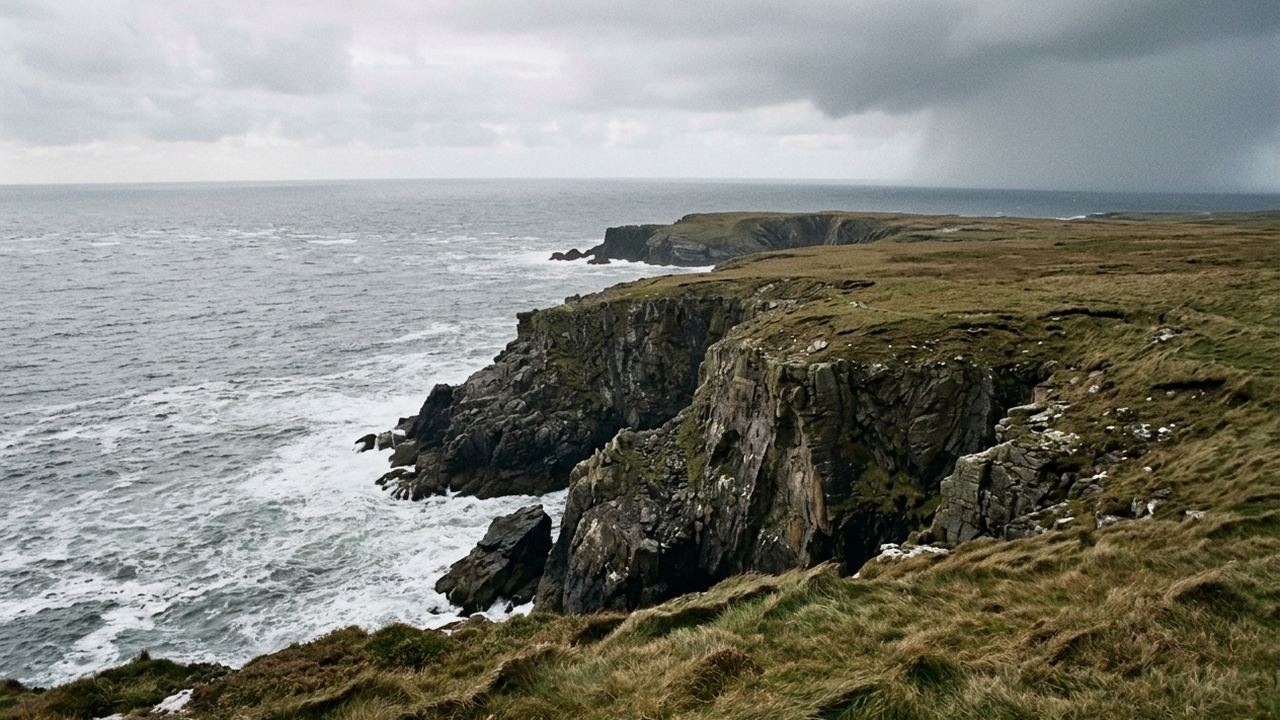
Most people who call about this coast have seen one photograph, and it is nearly always taken from the same place: the ridge above Slieve League, looking south along a cliff face that drops 1,972 feet into the Atlantic. That photograph is real. What it does not show is that the road to reach it leaves Dublin four hours earlier, and that the nearest town with more than one grocery store is forty minutes back the way you came.
So when you book a week in Donegal you are buying distance first and scenery second. The scenery is the reason. The distance is the price, and it is paid in hours behind the wheel rather than in dollars. That trade is the single largest difference between this week and the Connemara week people ask about in the same breath, often in the same sentence, sometimes without knowing they are two different counties four hours apart.
The other thing the photograph hides is how few people are in it. Along the Connemara coast in high summer you queue for a parking space. Here, on a Tuesday in June, you can walk a strand for an hour and pass two people and a dog.
- What the week is
- One rented house or guesthouse for all seven nights, a small hire car from Dublin or Knock, and days built around walking on headlands, strands and one or two inland hills.
- What sets it apart
- Dublin to the Donegal coast is about 4 hours by road against about 3 hours for Connemara, and Knock cuts it to roughly 2 hours 15 against about 1 hour 30; Slieve League's cliff face stands at 1,972 feet against roughly 700 feet on the Connemara coast; Donegal's whole coastline holds a fraction of Connemara's guesthouse stock, so July and August close early and shoulder weeks stay open; the floor here is $2,260 against a lower entry in Connemara, and the difference is fuel, mileage and a thinner supply of beds.
- What the figure covers
- Seven nights in one self-catering house or guesthouse room, booked for you; small hire car for seven days with unlimited mileage; a written day-by-day plan with parking places, gate details and turning points; two guided walking days with an independent local guide; ferry seats to Arranmore if your week includes it; all reservations held in your name and confirmed in writing.
- What it leaves to you
- Flights to Ireland or from any US city; fuel, tolls, car rental excess reduction and any charges the rental company adds at the counter; all food and drink, including the first shop for a self-catering house; entry to Glenveagh Castle and any paid site; the boat trip under the Slieve League face, which runs on its own schedule; anything you add locally; laundry; anything to do with insurance, which we neither sell nor arrange.
- Who this one is wrong for
- Anyone unwilling to drive on the left on single-track road with passing places and blind rises, since there is no week here without a car; anyone who wants a base within twenty minutes of everything, because the coast runs about 110 miles from Bundoran to Malin Head; anyone set on November through February, when daylight runs under eight hours and the high paths hold standing water; anyone whose walking has to stay flat, since the two guided days both carry 900 to 1,400 feet of ascent.
Ground that climbs straight out of the water
The coastline runs roughly 110 miles from Bundoran in the south to Malin Head at the top, and it does not run straight. Peninsulas push out four and five miles into the sea and the road follows every one of them, so a point eight miles away as a bird flies is often a thirty-five minute drive. Budget your days by driving time, never by map distance. From a base near Ardara, Glenveagh is about an hour and ten minutes; Malin Head is about two and a half hours each way, which makes it a full day and not an afternoon.
Underfoot the ground is blanket bog over rock. It holds water for days after rain and it stays soft in August. Boots that keep water out matter more than boots that are light. The two guided days both work on open hill: one climbs to the cliff-top path with about 900 feet of ascent on a graded track, the other takes 1,200 to 1,400 feet on unmarked ground with a guide reading the line. Between those, the strands at Maghera, Tramore and Five Finger are level walking on firm sand at low water, and at high water some of them are not walking at all.
Errigal, the quartzite cone visible from half the county, is 2,464 feet and takes most walkers three to four hours up and down on loose scree. It is not in the standard week. We will put it in if you ask, and we will say plainly what the surface is.
People arrive here having asked for something else
Half the questions that reach this office name one place and mean another. That is not a mistake on anyone's part; the two coasts photograph alike and get written about together. What separates them is measurable, so we measure it rather than argue about it.
Which months do what on this coast
The season is short and the shoulders are the interesting part. Daylight swings hard this far north: around 17 hours at midsummer and under 8 in December, which changes how much a day holds more than temperature does. Rain arrives on roughly 200 days a year somewhere in the county, usually in short passages rather than all day, and the wind off the Atlantic is the thing that actually decides whether the cliff path is comfortable.
- April to mid May
- Low 50s F, long light returning, most beds open, gorse in flower on the headlands
- Late May to June
- High 50s to low 60s F, longest days of the year, driest stretch on average, guided days run every week
- July and August
- Low to mid 60s F, all beds taken by February or March, boat trips under the cliff face most reliable
- September
- Back to high 50s F, water still warm enough for sea swimmers, beds reopen from about the second week
- October
- Low 50s F, strong Atlantic wind, cliff-top days moved inland when the forecast sits above 30 mph
- November to February
- Around 45 F, under 8 hours of daylight, high paths standing in water, guiding paused
From your message to a written figure
- 1. You write to us
- You name a month, how many people, and whether anyone in the group would rather not drive. A message that arrives during the day is opened before the working day ends
- 2. We check the beds
- We call the houses and guesthouses on your dates. This is the step that decides everything, since supply is thin and July is usually gone in winter
- 3. We price the week
- Car category, mileage between your base and what you want to see, guide days and the ferry if it applies. The figure comes to you in writing within two to four working days
- 4. You decide, or you do not
- The figure holds for fourteen days. We hold nothing on your card, and nothing is booked until you tell us to book it
Ask us the awkward question
The useful questions are the ones about driving hours, about what a specific week costs against the other coast, and about whether a particular walk suits the people actually coming. We will answer with figures. We will not tell you which of the two counties you should pick, because we sell both and you are the one who has to sit in the car.