Ask ten people what they mean by the Harz and eight describe the same photograph: dark spruce closing over a path, a steam engine climbing into it, half timbered houses below. Two of those three things are still there. When you book a walking week in the Harz you are booking into a forest that has been dying since 2018, and nobody at this office is going to pretend otherwise. Bark beetle following three dry summers took the spruce plantations across large parts of the plateau. Some of it stands dead and silver. Some was felled and hauled out, leaving open ground with stumps, brash and a great deal of sky.
What that does to a walking week is not simple. Views open where there were none, so you can see the shape of the block for the first time in a century, and the birch and rowan coming up through the brash are waist high in places. It also means shade is scarce on the tops, and a hot day on the Brocken plateau feels hotter than the map suggests.
The other thing people mean by the Harz is Bavaria, roughly. It is not. This is central Germany, four states away from the Alps, a worn Paleozoic block sitting alone in flat country with no mountains anywhere near it.
- What the week is
- Six nights in one Harz town, breakfast daily, a six-day regional rail and bus pass, one narrow gauge return ticket, printed route notes for eight marked day walks and a stamped path book.
- What sets it apart
- The Harz sits in central Germany about 2 hours 30 minutes by car from Hanover and roughly 4 hours from the Eifel; its high ground reaches 3,747 feet against the Eifel's 2,438; the walking is one fixed base reached by public rail rather than a moving route, and the price floor here is $1,940 for six nights; the spruce forest across large parts of the plateau is standing dead or already cleared, so the hillsides are gray and open rather than green and closed.
- What the figure covers
- Six nights in a family run guesthouse in one town, breakfast daily; a six-day regional rail and bus pass covering the whole massif; one return ticket on the steam narrow gauge line to the high plateau; printed notes and 1:30,000 mapping for eight marked day walks of 4 to 14 miles; a stamped path book for the network's checkpoint boxes; one evening meal on the first night; airport rail transfer from Hanover or Leipzig; a written itinerary with train times.
- What it leaves to you
- Flights to Germany and any onward transfer not listed above; all lunches and all evening meals after the first; drinks with any meal; entry to caves, mines, castles and museums, most of which charge $8 to $18; taxis if you finish a walk away from a station; the local visitor levy, which the guesthouse collects and which runs about $2.70 per person per night; additional narrow gauge journeys beyond the one return ticket; walking boots, poles and waterproofs; anything you buy at a checkpoint box; tips.
- Who this one is wrong for
- Anyone who wants to change town every night, since this is one bed for six nights; anyone who will not walk 4 miles on wet rock and root; anyone counting on green forest photographs, because much of the spruce is dead; anyone traveling in January or February, when snow closes the high paths and the timetable thins.
Rock, root and the wet under your boots
The high point is the Brocken at 3,747 feet, and the block falls away from it in every direction to farmland at around 500 feet. That gives you real ascent without any altitude: a typical day out of a valley town climbs 1,300 to 2,000 feet, most of it in the first two hours, on granite and slate.
Surfaces vary more than the contour lines warn. Forest road is smooth and fast. The older marked paths are granite blocks, exposed spruce root and, on the plateau approaches, boardwalk over peat bog that is slick whenever it is wet, which is often. The summit plateau holds raised bog and stays damp in weeks when the valleys are dry. Expect 2 to 3 miles an hour on road, and closer to 1.5 on rooted descent.
The network itself is the reason people come back. Paths are marked, junctions are signed with distances and walking times, and 222 numbered checkpoint boxes are scattered across the massif, each holding a rubber stamp for the book in your pack. Collecting stamps is not a game the office invented; it is the reason half the German walkers you pass are taking a detour to a rock you would otherwise ignore.
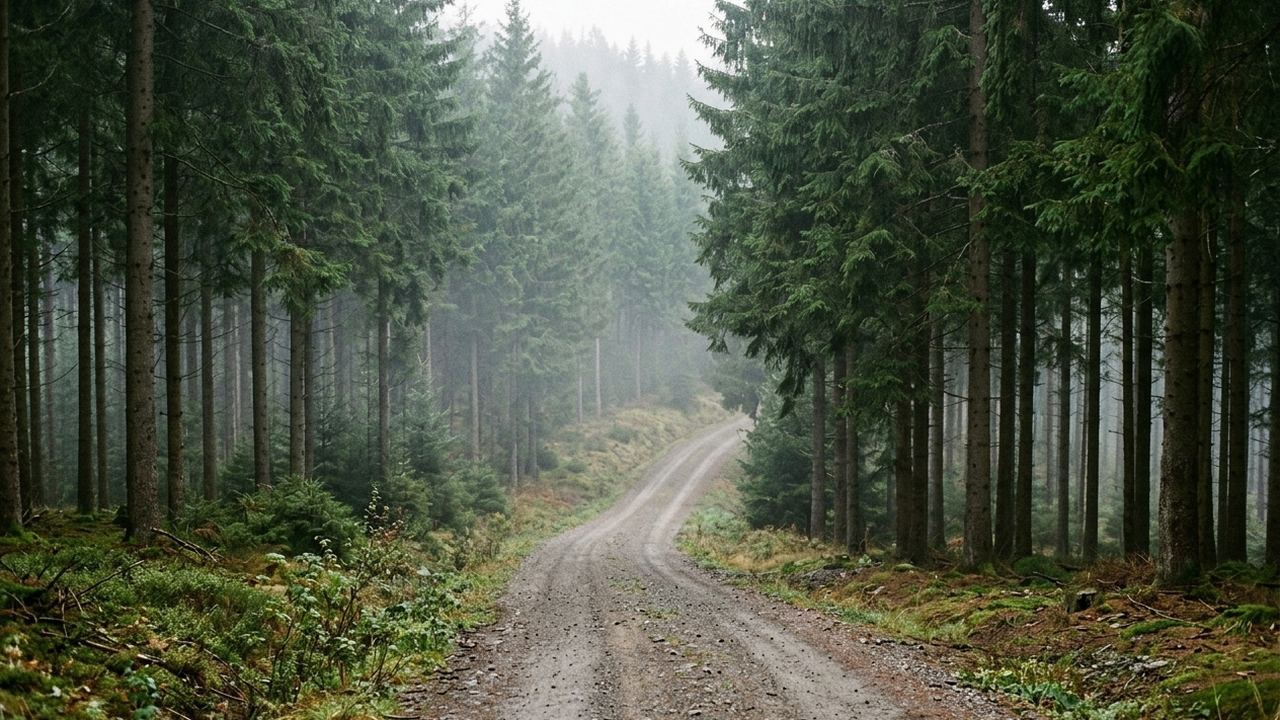
Arriving with a different mountain in your head
Most people who write to us about this place are describing something else, and it is usually worth naming what before we quote anything.
Which months do what up here
The plateau makes its own weather and the valleys often do not share it. The summit records fog on roughly 300 days a year and averages around 34F across the year; a town at 800 feet can be 15 degrees warmer on the same afternoon. Rain is spread through the year rather than concentrated, so there is no dry season to aim at, only a warm one.
- Late April to mid May
- Larch green, water high, plateau boardwalk still wet, guesthouses quiet and at their season low
- June to August
- Warmest, 68F to 77F in the valleys, longest daylight, school holidays fill towns from late July
- September to mid October
- Steadiest walking weather, cool mornings, beech color in the lower valleys from the first week of October
- Late October to December
- Fog and short days, some upper paths unmarked once leaves cover them, steam timetable reduced
- January and February
- Snow on the plateau, cross country trails take over, several summer paths closed and not maintained
- March
- Thaw, mud, meltwater over paths, the least predictable month of the twelve
From your message to a written figure
- 1. You write
- Tell us the month, the number of walkers and how far you want to walk on an average day. A message is opened before the working day ends
- 2. We check the ground
- We ask two or three guesthouses in the towns that suit your daily distance, and confirm which narrow gauge services run in your dates
- 3. A written figure
- You get a full itemized figure, with the eight walks named and the train times set out, in two to four working days
- 4. You decide
- Nothing is held and nothing is charged until you say yes in writing. If you want the Eifel figure alongside this one, ask, and we send both without a preference
Ask us the awkward part
The useful questions are the ones about mud, distance and what the hillsides actually look like this year. Tell us the month you are thinking of and how far you are willing to walk in a day, and we will answer with figures rather than adjectives.