Northumberland is 1,936 square miles with about 320,000 people in it, which works out at fewer residents than a mid-sized North Carolina county spread over an area larger than Delaware and Rhode Island together. That ratio is the whole thing. People who book a week in Northumberland usually say they want castles, and they get them, nine of consequence along the coast alone. What surprises them is the space between the castles: long empty roads, a shoreline where a two mile beach can hold six cars in the parking area at eleven in the morning in August, and a sky at night with no town glow on the horizon in any direction.
The other thing people say is that they were also looking at Exmoor. That comparison comes up in this office more often than any other, and it is a reasonable one to hold in your head, because both are places you go to be outdoors in a rented house with a car. They are not, in the end, doing the same thing. Exmoor National Park covers 267 square miles. Northumberland has 572 square miles of dark sky park alone, and the county around it is nine times the size of the whole of Exmoor. What that means practically is that a week here is a driving week, and a week on Exmoor need not be.
- What the week is
- Six nights in one rented house between the coast and the wall country, a hire car from arrival to departure, and a written day plan that leaves every day optional.
- What sets it apart
- Northumberland is roughly nine times the land area of Exmoor National Park, so the driving is real: 55 miles from Bamburgh to Hexham, about ninety minutes each way. Nothing in it climbs above 2,676 feet, and the coastal walking is flat sand rather than combe and hill. It sits on the North Sea, not the Bristol Channel, which puts July daytime highs near 65F rather than the low seventies. Its dark sky park covers 572 square miles, the largest area of protected night sky in Europe.
- What the figure covers
- Six nights in one self-catering house, sleeping four to six, booked in your name; a compact hire car from arrival to the morning of departure, unlimited mileage, collected and returned at Newcastle; a written route book of nine day options with driving times, parking notes and tide-dependent crossings; entry arranged in advance for two castles and one Roman fort; one guided evening at an observatory site in the dark sky park, weather permitting, with the alternative date already held.
- What it leaves to you
- Flights to and from the UK and any onward domestic travel; fuel, road tolls, car parking charges and any car rental excess reduction you choose to add; all food and drink for six days, including the shopping you do on arrival; entry to any site not named above, including boat landings to the islands; the ferry crossing to the Farne Islands and to Lindisfarne if the tide table pushes you to a boat; luggage charges; anything you add to the house booking such as extra guests, dogs or late departure; gratuities.
- Who this one is wrong for
- Anyone who does not want to drive on the left on single-carriageway roads, because the week does not work without the car; anyone hoping to walk everywhere from the door, since the interesting ground is spread across 55 miles; anyone who wants warm swimming, as the North Sea sits between 46F and 59F all year; and anyone booking November through February who expects daylight, because the sun sets before 4pm.
Sand, whin sill and a wall built on a ridge
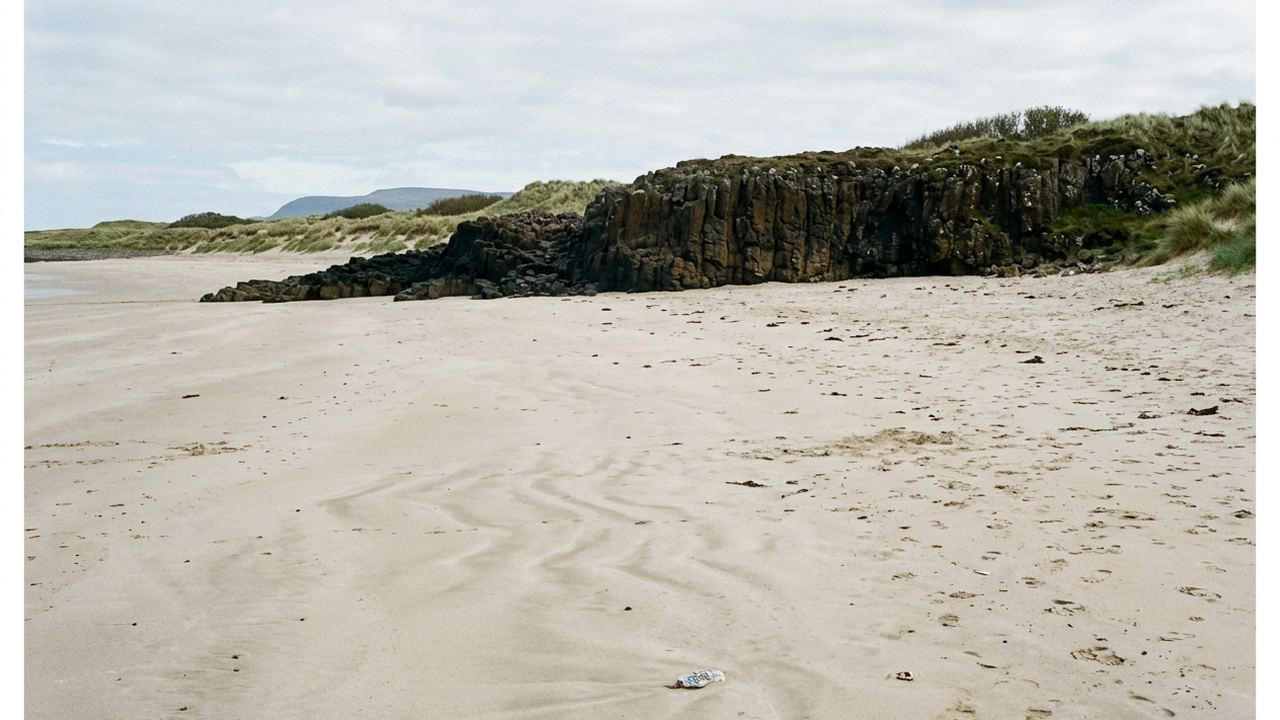
The coast is flat. From Amble north to Berwick, roughly 40 miles of shoreline, the walking surface is firm sand at low water and marram-covered dune behind it. There is almost no ascent. The exceptions are the whin sill outcrops, a band of hard dark rock that pushes up through the softer ground at intervals and which is the reason the castles sit where they do: Bamburgh, Dunstanburgh and Lindisfarne all stand on it. Climbing to Dunstanburgh from Craster is a mile and a half of level coastal path with perhaps 80 feet of rise at the end.
Inland is different ground. The wall country runs east to west across the middle of the county along the same whin sill ridge, and the section between Housesteads and Steel Rigg is where it is most dramatic, because the rock face drops away northward and the wall follows the top of it. Walking that stretch is genuine up and down: about 100 to 130 feet of climb repeated eight or nine times over four miles, with stone steps and a lot of stile crossings. It is not high, but it is not level either.
Further west and south the county turns to forest and moor. Kielder Water and Forest Park is 250 square miles of planted spruce and a reservoir with a 27 mile shore road. It is where the observatory sits, and it is also the least populated corner: the drive from the coast to Kielder is around 70 miles and takes about two hours on B roads.
The people who arrive here having asked for something else
Most of the confusion is honest and specific. Somebody has an idea in their head that is made of two or three real things, and only some of those things live in this county. Here is what the office hears most.
Twelve months on a north-facing coast
The year here is long at both ends and short in the middle. Northumberland sits at 55 degrees north, further north than any point in the lower 48 states, which does more to the daylight than it does to the temperature. Midsummer gives you around seventeen hours of light and a dusk that never fully goes; midwinter gives you seven, and the sun is down before four in the afternoon.
- March to April
- Cold and bright, highs 46F to 52F, wind off the sea most days; puffins return to the islands from late April
- May to June
- The driest stretch, highs 57F to 63F, long light until after 9pm, and the coast paths are quiet before the schools break
- July to August
- Warmest at 63F to 67F, busiest by a wide margin, houses on the coast fill nine to twelve months out
- September to October
- Highs 54F to 61F, sea at its warmest of the year, castle sites much quieter, first clear dark nights return
- November to February
- Highs 41F to 46F, sunset before 4pm, best conditions for the dark sky park and the worst for daylight walking
- Any month
- Rain falls on roughly 130 days a year, spread evenly, and the wind is the thing you notice more than the rain
Between your message and a written figure
- 1. You write
- Tell us the six nights you want, how many people and whether anyone needs a ground floor bedroom. We open messages the same working day, before the working day ends.
- 2. We check the ground
- We hold two or three houses in the area that suits what you described and check the car class against the group size and luggage. Coastal houses in July and August are the constraint, not the car.
- 3. You get a figure
- A written breakdown reaches you in two to four working days: the house, the car, the arranged entries and the observatory evening, with what is not in the number set out separately.
- 4. You decide, or you ask again
- Nothing is held with money at this stage. If the figure sends you back toward the other place you were weighing, say so and we will set the two out in facts.
Raise the difficult part now
The useful questions are the ones people feel silly asking: how far is it really from the house to the wall, will the car take four adults and their bags, what happens if the tide closes the causeway on the one day we planned it. Those are the questions that decide whether a week works, and they are better asked now than found out on a Tuesday afternoon. Write with the dates and the number of people and we will answer with figures rather than adjectives.