Half the people who call about this part of France are describing somewhere else. They say walnut country, they say a river with cliffs, they say a village with a market on Saturday, and they say all of it in the same breath as Provence. Then they hear the drive between the two and go quiet. So it is worth being plain at the start: you can book a week in the Quercy and get limestone, water, caves and walnut orchards, and you will not get lavender fields, the Mediterranean light, or a restaurant every four miles.
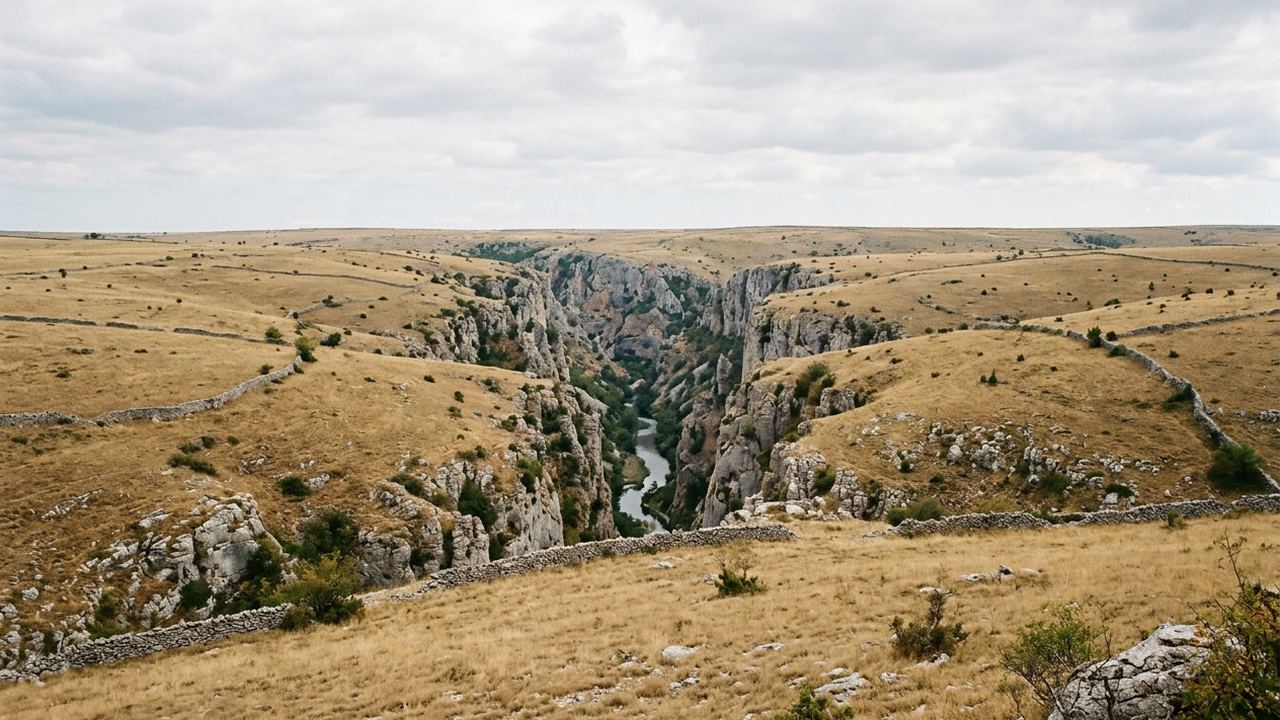
The Quercy is the old province around Cahors and Figeac, a limestone plateau split by two rivers. The Lot runs through the southern half in tight loops with cliffs on the outside of each bend. The Dordogne comes across the north. Between them the ground is causse: thin soil over rock, dry stone walls, juniper, sheep, and stone huts built without mortar that people still argue about the age of. It holds water badly on the surface and beautifully underneath, which is why the caves are here.
What that means for a week is more driving and fewer people. Villages sit twenty to forty minutes apart on roads that follow the rock rather than the map. You will not sit in traffic. You will also not stumble on somewhere to eat at nine in the evening in October.
- What the week is
- One rented house or hotel base, a hire car for the whole week, and days built around two river valleys, the dry plateau between them, and two or three cave sites booked in advance.
- What sets it apart
- The Quercy sits about 300 miles northwest of the Luberon, roughly five and a half hours of driving between the two; our Quercy week starts at $2,210 per person against a Luberon week that runs about a third higher; the plateau is limestone causse at 900 to 1,300 feet with river gorges cut 400 feet below it, not a south-facing range above open farmland; the cave sites here take timed entry and the summer slots are gone by March, while the Quercy's own high season is short and August thins out fast once the walnut harvest approaches.
- What the figure covers
- Seven nights in one base, either a village house or a small hotel; hire car for seven days, category B, unlimited mileage; timed entry to two cave sites of your choosing, booked by us at the time we hold the week; a driving book for the week with parking notes for each village, because most of them have one lot and it is outside the walls; a written figure valid for thirty days.
- What it leaves to you
- Flights to and from France, and the transfer from your arrival airport to the base; fuel, tolls and any second driver on the hire car; all meals, including breakfast unless the base is a hotel that serves it; entry to anything beyond the two booked cave sites, including the smaller caves, the abbey and the market town museums; the deposit the hire company holds against the card at the desk; anything you add after the figure is written.
- Who this one is wrong for
- Anyone who does not want to drive. The week does not work without a car: there is no useful rail between the villages, taxi coverage on the causse is thin, and a typical day here is fifty to ninety minutes behind the wheel. It is also wrong for anyone who wants dinner within walking distance every night, since most bases have one restaurant in the village and it closes two days a week outside July and August, and wrong for anyone set on swimming weather, which on the rivers means late June through early September and nothing either side of that.
Rock that drains, and roads that follow it
The plateau runs between about 900 and 1,300 feet, and the rivers have cut down through it roughly 400 feet, so almost every arrival at a village involves a descent, a bridge and a climb. The gradients are ordinary. The corners are not; a twelve mile hop can take thirty five minutes and the satellite navigation will insist otherwise until you are on it.
Walking here divides cleanly into two kinds. On the causse it is flat to gently rolling, on white stone tracks with almost no shade and no water, which is why summer walkers on the plateau start at seven in the morning and stop by eleven. In the valleys it is short, steep and shaded: 300 to 500 feet of ascent from the river to a clifftop viewpoint, usually on steps or a stone path, usually taking under an hour each way.
The caves are the other reason people come and the reason to plan. The painted and engraved sites in the region take timed entry with a fixed number of people a day, and the count is set by conservation rather than demand. Summer slots typically go in February and March. We book two of them when we hold your week, which is why we ask which ones early rather than late.
People who arrive here having asked for Provence
Nobody is wrong to confuse the two. They share stone villages, markets, walnuts in the cooking and heat in August. The differences are mostly ones of distance and density, so here they are as facts rather than as an argument.
The year on the causse, month by month
The plateau exaggerates the seasons. Stone holds heat, thin soil gives it up fast, and the rivers set their own timetable for swimming and for the boats. The short answer is that April to June and September are the wide part of the year, July and August are hot and busy on the water, and the middle of winter closes a good deal of what you would have come for.
- April to mid May
- Green, 60s in the afternoon, waterfalls and springs running; some restaurants still on winter days
- Late May to June
- Markets in full swing, high 70s, cave slots still findable, river cold but swimmable by late June
- July and August
- Upper 80s to mid 90s on the causse, valleys busier, cave tickets long gone unless held in winter, walnut orchards in full leaf
- September
- Mid 70s by day, low 50s at night, harvest starting, water still warm enough into the first week or two
- October
- Walnut harvest proper, color in the valleys, half the smaller sites on reduced days from mid month
- November to March
- Cold, wet on the plateau, many caves and most river operators shut; villages quiet in a way some people want and most do not
From your message to a written figure
- 1. You write
- You tell us the week, the number of people, and which two cave sites you want. If you do not know the sites yet, say so and we will send the list with what each one actually is
- 2. We check
- We put the dates against a base and against cave availability at the same time, because those two things fail independently and there is no point holding one without the other
- 3. You get a figure
- A written figure, itemized, with the base named, the car category stated, and the two cave slots identified by date and time. Two to four working days
- 4. You decide
- The figure stands for thirty days. Nothing is held against your name until you say yes in writing, and no card details are taken on this site
Ask us something specific
The most useful message names a week and a number of people, and says whether anyone in the group would rather not drive the valley roads. That last one changes which base we suggest more than anything else you can tell us. The Briar Review books the house, the car and the cave slots; other companies own them, drive them and guide them.